

IVR vs AI Phone Agent: Comparison, Features, Benefits, and Which One Fits Your Business?
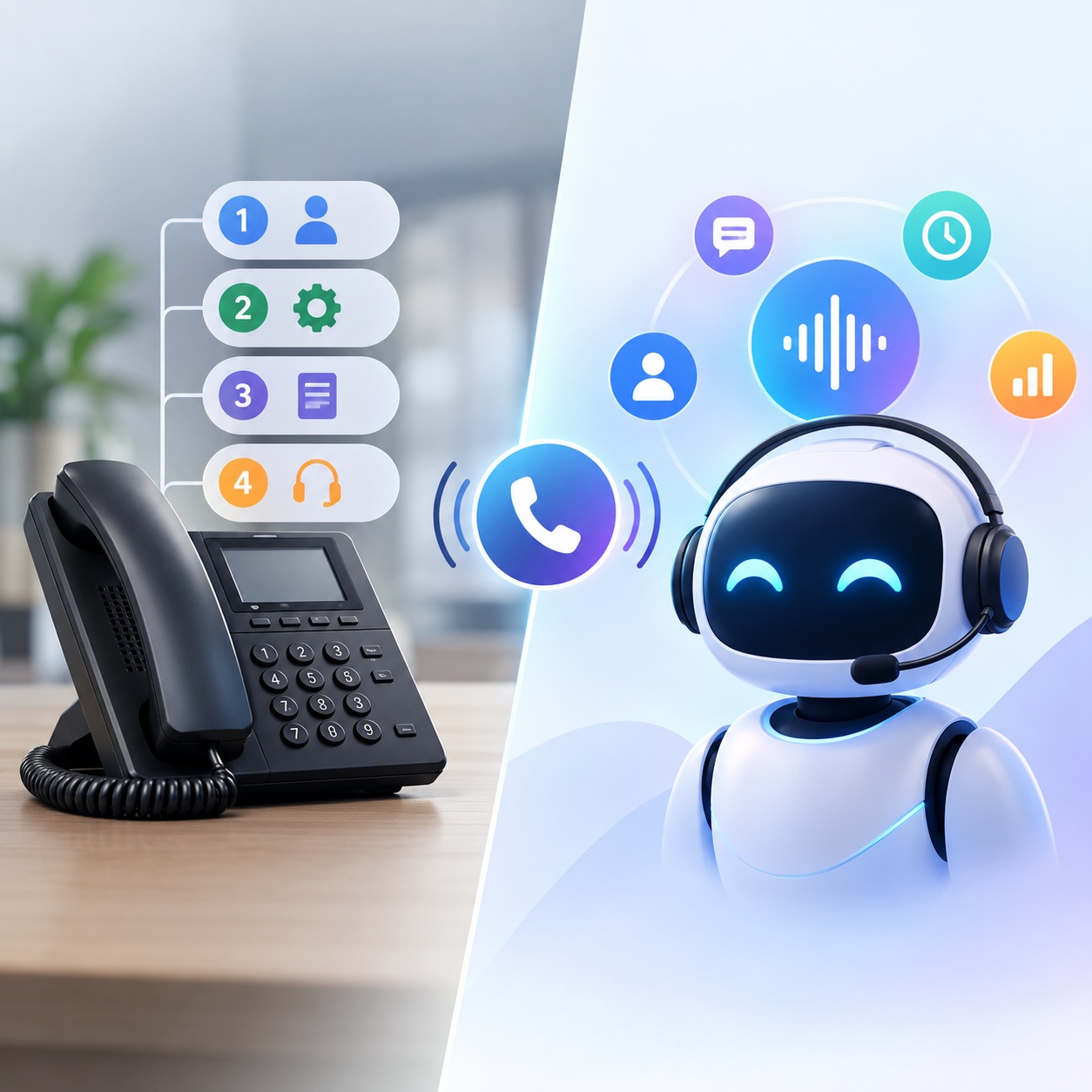
When a customer calls a business today, the first few seconds can shape the entire experience. If they immediately hear, “Press 1 for sales, press 2 for support, press 3 for billing,” they know they have reached an automated phone system. That system is usually an Interactive Voice Response (IVR) platform.
But there is another approach becoming increasingly practical: the AI phone agent.
Instead of navigating a menu, a caller can simply explain what they need. An AI phone agent can interpret natural language, ask follow-up questions, retrieve information, and—in properly integrated systems—perform actions such as scheduling an appointment, updating a record, qualifying a lead, or transferring the call to the appropriate employee.
So, IVR vs AI phone agent: what is the difference, and which one should a business use?
The answer depends on what you expect your phone system to accomplish.
Traditional IVR is primarily designed around structured call flows and predefined choices. AI phone agents are designed around conversational interactions and dynamic responses. Modern systems can also combine the two rather than forcing businesses to choose one exclusively.
IBM defines IVR as an automated telephone system that allows callers to provide or receive information through voice or menu inputs, while newer conversational AI systems can understand intent and engage in more flexible interactions.
That distinction matters because customer expectations have changed. People don’t necessarily want to remember which number corresponds to which department. They want to explain their problem and get it solved.
Imagine two callers.
The first says:
“Press 2.”
The second says:
“Hi, I need to reschedule my appointment for Thursday afternoon. Is there anything available?”
The first interaction is menu-driven. The second requires understanding context, intent, and potentially accessing a scheduling system.
That is where AI phone agents can offer a fundamentally different experience.
What Is an IVR System?
Interactive Voice Response (IVR) is an automated telephone system that uses voice prompts, keypad inputs, speech recognition, or predefined workflows to guide callers and complete specific tasks.
IVR has been around for decades, and there is a reason businesses continue to use it. It solves a very practical problem: how do you manage a large volume of incoming calls without requiring a human employee to answer every call?
A traditional IVR might greet callers with something like:
“Thank you for calling ABC Company. Press 1 for sales, press 2 for customer support, press 3 for billing, or press 4 to hear these options again.”
The caller makes a selection, and the system follows the corresponding workflow.
At its simplest, IVR relies on DTMF keypad inputs. More advanced implementations can recognize spoken commands and use speech recognition or natural-language processing. AWS describes IVR systems as technologies that let customers interact through voice menus or number pads and then either complete tasks or reach the appropriate representative.
How does traditional IVR work?
A typical IVR process looks something like this:
- The customer calls a business number.
- The phone system identifies the incoming call.
- A recorded or synthesized greeting plays.
- The caller selects an option using the keypad or voice.
- The system identifies the corresponding workflow.
- The caller provides additional information if required.
- The IVR retrieves information or routes the call.
- The customer either completes the task or reaches a human agent.
For example, imagine a utility company.
A caller might select:
- 1 for account balance
- 2 for payment
- 3 for service outage
- 4 for technical support
The system can then connect the caller to the appropriate process.
This structure makes IVR predictable. The business knows exactly what paths customers can take.
That predictability is one of IVR’s greatest strengths.
It can also be a limitation.
If a caller has a problem that doesn’t fit neatly into the menu, the system may struggle. The customer might need to move through several options before finally reaching a person.
Modern IVR platforms can be much more sophisticated than the stereotypical “press 1, press 2” experience. Natural-language IVR can allow callers to describe requests using speech, while conversational AI can further improve how systems understand and respond to those requests.
The important distinction is therefore not simply old IVR vs new IVR.
It is structured automation vs conversational automation.
What Is an AI Phone Agent?
An AI phone agent is a voice-based artificial intelligence system that can understand spoken language, maintain conversational context, generate responses, and potentially perform business tasks during a phone call.
Instead of forcing customers through a predefined menu, an AI phone agent can allow them to speak naturally.
For example:
Caller:
“Hi, I need to book an appointment with a dentist next week.”
AI phone agent:
“Sure. Do you prefer Monday, Wednesday, or Friday?”
Caller:
“Wednesday.”
AI phone agent:
“We have 10:30 AM and 2:00 PM available. Which works better?”
That is fundamentally different from:
“Press 1 to book an appointment. Press 2 to change an appointment. Press 3 to cancel.”
The AI agent is attempting to understand the intent behind the conversation, rather than simply identifying a menu selection.
Modern AI voice-agent architectures commonly combine speech recognition, language-model reasoning, text-to-speech, telephony infrastructure, and integrations with business systems. AWS describes voice-agent architectures that combine real-time speech understanding, LLM-based processing, text-to-speech, telephony integration, session awareness, and memory handoffs.
This opens the door to much more flexible workflows.
What can an AI phone agent potentially do?
Depending on its integrations and configuration, an AI phone agent can:
- Answer frequently asked questions
- Qualify leads
- Schedule appointments
- Reschedule appointments
- Confirm bookings
- Collect customer information
- Check order or account information
- Route calls
- Capture messages
- Perform basic troubleshooting
- Send information through connected systems
- Escalate complex situations to employees
- Handle calls outside normal business hours
The crucial phrase is “depending on its integrations.”
An AI phone agent should not be treated as magical software capable of automatically accessing every business system.
If you want an agent to schedule appointments, it needs access to an appropriate scheduling system. If it needs to look up customer records, it requires a secure integration with the relevant database or CRM.
This is why implementation quality matters as much as the AI model itself.
IBM describes AI agents as systems capable of autonomously performing tasks by designing workflows and using available tools to interact with external environments.
That distinction helps explain why an AI phone agent can go beyond answering questions.
It can potentially take action.
IVR vs AI Phone Agent: The Core Differences
The simplest way to understand IVR vs AI phone agent is to think about how each system handles conversation.
Traditional IVR asks:
“Which option do you want?”
An AI phone agent asks:
“How can I help?”
That sounds like a small difference, but operationally it can be significant.
| Feature | Traditional IVR | AI Phone Agent |
| Interaction style | Menu-driven | Conversational |
| Keypad support | Yes | Usually possible |
| Natural conversation | Limited | Core capability |
| Predefined workflows | Strong | Flexible |
| Intent understanding | Limited to configured capabilities | More advanced |
| Context awareness | Usually limited | Can maintain conversational context |
| Follow-up questions | Scripted | Dynamic |
| FAQ handling | Predefined | Knowledge-based |
| Task execution | Rule-based integrations | Tool/API-based integrations |
| Call routing | Strong | Intelligent/contextual |
| Personalization | Limited to available data | Potentially highly personalized |
| Complex conversations | Difficult | Better suited |
| Human escalation | Yes | Yes |
| 24/7 availability | Yes | Yes |
| Maintenance | Workflow/menu updates | Knowledge, prompts, integrations, testing |
| Predictability | Very high | More variable |
| Best for | Structured processes | Dynamic conversations |
Traditional IVR is excellent when the customer journey is predictable.
Suppose a business receives thousands of calls asking for three things:
- Store hours
- Location
- Order status
An IVR can handle those requests efficiently.
But imagine a home-services company receiving calls like:
“I saw your website and need someone to look at a water leak. It’s getting worse, and I’m wondering if someone can come today.”
There may be several pieces of information hidden inside that statement:
- The caller is a potential customer.
- The service is plumbing.
- The issue may be urgent.
- The caller wants availability.
- The caller may be geographically relevant.
- The business may want to capture contact details.
A conversational AI agent can be designed to identify those elements and continue the conversation.
This is where AI phone agents can become particularly useful for lead generation and service businesses.
However, businesses should not automatically replace every IVR with AI.
A structured menu can be easier to audit, easier to predict, and simpler for highly standardized processes.
The better question is:
How complicated are your customers’ conversations?
If customers typically select one of five known options, IVR may be sufficient.
If customers frequently explain unique situations in their own words, an AI phone agent may provide a more natural experience.
Modern contact-center platforms increasingly support both approaches. AWS, for example, documents conversational AI bots that can be used within IVR experiences to understand customer intent, ask follow-up questions, and automate issue resolution.
So the future isn’t necessarily IVR versus AI.
In many cases, it is IVR plus AI.
Key Features and Benefits of IVR
IVR remains valuable because it provides businesses with a controlled and repeatable way to automate telephone interactions.
1. Predictable call routing
One of the biggest advantages of IVR is straightforward routing.
A caller chooses an option and is directed toward the relevant department or workflow.
For organizations with clearly separated departments, this can be highly effective.
For example:
Press 1 → Sales
Press 2 → Billing
Press 3 → Technical Support
Press 4 → Existing Orders
The system doesn’t need to interpret a complicated conversation. It simply follows the configured logic.
2. Reduced pressure on employees
IVR can handle routine interactions without requiring an employee to answer every call.
That allows human representatives to focus on calls that genuinely require human involvement.
For example, a business could automate:
- Business hours
- Directions
- Basic account information
- Appointment confirmation
- Simple routing
- Frequently requested information
AWS notes that IVR can reduce wait times and help organizations analyze call flows to identify common customer-service barriers.
3. 24/7 availability
An IVR system doesn’t need to leave the office at 5 p.m.
Customers can call outside normal business hours and still receive information or leave a message.
This can be particularly valuable for:
- Healthcare practices
- Home-service businesses
- Property management
- Restaurants
- E-commerce
- Travel companies
- Financial services
- Emergency-oriented service businesses
4. Consistent customer journeys
Human employees may phrase things differently from one call to another.
IVR provides a standardized process.
For regulated or highly structured environments, this predictability can be useful because the organization controls exactly what information is presented and which steps the customer follows.
5. Straightforward integration
IVR systems can integrate with databases, customer-service platforms, telephony infrastructure, and business applications.
For example, an IVR could allow a caller to enter an account number and then retrieve relevant information.
AWS documentation describes IVR systems communicating with application servers and business applications to retrieve information such as flight-status data.
6. Scalability
Once a workflow has been properly configured, the same automated process can serve many callers.
The system doesn’t need to hire another employee simply because call volume increases during certain periods.
Where IVR starts to struggle
The limitation becomes obvious when the caller doesn’t fit the menu.
Consider this interaction:
System:
“Press 1 for billing. Press 2 for sales. Press 3 for support.”
Caller:
“I’ve been charged twice for an order that was delivered damaged, and I need to speak to someone about getting a replacement.”
Which number should they press?
That’s precisely the type of situation where conversational AI can offer a different experience.
Key Features and Benefits of AI Phone Agents
AI phone agents are designed to make telephone interactions feel less like navigating a menu and more like having a conversation.
The technology typically combines speech-to-text, natural-language understanding, AI reasoning, text-to-speech, telephony, business-system integrations, and workflow automation.
1. Natural-language conversations
A caller can explain what they need in their own words.
They don’t necessarily need to know the company’s internal department structure.
For example:
“I’m calling because my delivery hasn’t arrived and I need to know where it is.”
An AI agent can interpret the intent as an order-status request and, if integrated with the relevant system, potentially retrieve the appropriate information.
2. Contextual follow-up questions
An AI phone agent can ask questions based on previous answers.
For example:
Caller:
“I want to schedule a service.”
Agent:
“Sure. What type of service do you need?”
Caller:
“Air-conditioner repair.”
Agent:
“Got it. Is the system completely down, or is it still producing some cool air?”
The second question depends on the first answer.
That’s very different from a rigid menu tree.
3. Lead qualification
For service businesses, this can be one of the most interesting use cases.
An AI phone agent could ask:
- What service do you need?
- Where is the property located?
- When do you need the service?
- Is this an existing customer?
- What is the best callback number?
- How urgent is the request?
The answers can then be passed into a CRM or lead-management system, depending on the integration.
4. Appointment scheduling
With the right calendar or scheduling integration, an AI phone agent can potentially:
- Check availability
- Offer available times
- Book appointments
- Reschedule appointments
- Cancel appointments
- Confirm appointment details
This can eliminate unnecessary back-and-forth for both customers and employees.
5. 24/7 conversational support
Like IVR, AI phone agents can operate outside traditional business hours.
But instead of simply recording a message, they can potentially answer questions and complete supported workflows.
IBM notes that conversational AI can help customer-service teams provide real-time support and automate routine inquiries, while AI agents can go beyond FAQs by interacting with external systems and performing actions.
6. Multilingual capabilities
Modern speech technologies can support multiple languages and regional accents, depending on the selected platform.
For businesses serving multilingual audiences, this can make phone support more accessible. AWS, for example, documents text-to-speech capabilities across multiple languages and regional accents.
7. Human handoff
A good AI phone agent should know when not to continue.
If a caller asks for something outside its authority, becomes frustrated, or needs specialized assistance, the system can route the call to a human.
This hybrid approach is often more practical than trying to automate everything.
8. Integration with business tools
The real power of an AI phone agent often comes from integrations.
An AI voice system by itself can have a conversation.
An integrated AI agent can potentially do something with that conversation.
For example:
Phone call → AI understands request → CRM lookup → calendar check → appointment booked → confirmation sent
That turns voice automation from a simple answering system into a business workflow.
AWS describes modern voice-agent architectures that connect speech processing, LLM reasoning, telephony, session context, and external tools.
And that’s ultimately the biggest difference.
IVR automates the path through a phone system.
An AI phone agent can automate parts of the conversation and the work behind it.
IVR vs AI Phone Agent: Which Provides a Better Customer Experience?
The customer experience is often where the difference between IVR and an AI phone agent becomes most noticeable.
Think about the last time you called a company and heard a long list of menu options. You may have listened carefully, chosen an option, waited, selected another option, and eventually discovered that none of the choices actually described your problem.
That experience is not necessarily caused by IVR itself. Poorly designed IVR is the problem.
A well-designed IVR can be fast and convenient when customers have simple, predictable needs. For example, someone calling a restaurant to confirm its opening hours does not need a sophisticated AI conversation. A simple automated response can provide the information in seconds.
The problem occurs when the caller’s request doesn’t fit neatly into the predefined menu.
An AI phone agent approaches the interaction differently. Rather than asking the caller to understand the company’s organizational structure, it allows the caller to explain the situation naturally.
For example:
Caller:
“I’ve been trying to reach someone about my roof repair estimate. I received an email yesterday, but I have a question about the price.”
An AI phone agent could identify several pieces of information from that statement and ask an appropriate follow-up question.
This creates a more natural experience because customers don’t have to translate their problem into a menu option.
Where IVR can still deliver an excellent experience
IVR works particularly well when:
- Call volumes are high.
- Customer requests are predictable.
- Departments are clearly separated.
- The business needs strict workflow control.
- Customers frequently need basic information.
- The organization already has a mature call-routing infrastructure.
For example, a bank may use IVR for structured services such as checking balances, identifying branches, or routing customers to specific departments.
Where AI phone agents have an advantage
AI phone agents become more useful when callers frequently:
- Describe problems in their own words.
- Ask several related questions.
- Need personalized information.
- Need appointments or reservations.
- Require lead qualification.
- Change their request during the conversation.
- Need assistance outside business hours.
The distinction can be summarized simply:
IVR is optimized for navigating choices. AI phone agents are optimized for understanding conversations.
That doesn’t make one universally superior.
A business with simple call flows may gain little from replacing a perfectly functional IVR. Meanwhile, a business receiving complicated service requests may find that conversational automation solves problems that menu-based automation cannot handle efficiently.
The best customer experience is often achieved by matching the technology to the complexity of the customer’s request.
IVR vs AI Phone Agent: Cost, Scalability, and ROI
Cost is one of the first questions business owners ask when comparing IVR vs AI phone agents.
Unfortunately, there is no universal price that applies to every business. Costs depend on call volume, platform, telephony provider, integrations, AI usage, development requirements, security requirements, and the complexity of the workflow.
Traditional IVR can be relatively economical when the business only needs simple routing and automated information.
An AI phone agent may require more sophisticated infrastructure because it can involve speech recognition, AI processing, voice generation, databases, APIs, CRM integrations, monitoring, and ongoing optimization.
But looking only at software cost can produce the wrong conclusion.
The better question is:
What does the technology accomplish for the business?
Imagine a landscaping company receives 100 calls every week. Many callers ask about services, pricing, service areas, availability, and estimates.
An IVR might route callers to sales.
An AI phone agent could potentially answer basic questions, collect project details, qualify leads, and schedule consultations.
If that automation helps the company respond to more prospects and reduces missed opportunities, the ROI calculation changes.
A simple ROI framework
Businesses can evaluate an AI phone system using:
Potential value = labor savings + additional opportunities captured + improved conversion value − technology and implementation costs
Consider a hypothetical example.
Suppose a company misses 20 qualified calls each month because employees are busy.
If an AI phone agent captures those calls, collects lead information, and schedules consultations, the business can calculate how many additional customers those leads generate.
For example:
- 20 additional qualified calls
- 50% become appointments
- 40% of appointments become customers
- Average customer value = $1,000
That would represent:
20 × 50% × 40% × $1,000 = $4,000 in potential monthly customer value
This is only an illustration—not a guarantee. Actual results depend on lead quality, conversion rates, pricing, market conditions, and implementation quality.
Scalability is another important factor
An IVR can handle large numbers of calls because automated menu logic doesn’t require a human employee.
AI phone agents offer similar scalability while potentially handling more complicated interactions.
But scalability introduces another requirement: quality control.
If an AI agent handles 10 calls per day and makes an occasional mistake, the impact may be small.
If it handles 10,000 calls per day, even a small error rate can create significant customer-service problems.
That’s why businesses should monitor:
- Call outcomes
- Transfer rates
- Abandoned calls
- Customer complaints
- Misunderstood requests
- Failed integrations
- Incorrect responses
- Escalation frequency
- Appointment accuracy
The goal isn’t simply to automate more calls.
The goal is to automate the right calls successfully.
AI Phone Agent vs IVR: Limitations and Potential Risks
AI phone agents can be powerful, but businesses should not treat them as flawless digital employees.
They have limitations.
The same is true for IVR.
Understanding those limitations before implementation can prevent expensive mistakes.
IVR limitations
Traditional IVR can become frustrating when menus are too long or poorly organized.
Common problems include:
- Too many menu options
- Repetitive prompts
- Difficulty reaching a human
- Limited understanding of unusual requests
- Rigid workflows
- Poor speech recognition
- Requiring customers to repeat information
- Lack of context between departments
A caller may know exactly what they need but still have difficulty finding the correct menu.
This is sometimes called a menu maze.
The solution isn’t necessarily to eliminate IVR. Often, businesses can simplify the menu structure and provide a clear route to human assistance.
AI phone-agent limitations
AI systems have different risks.
An AI agent may misunderstand:
- Names
- Addresses
- Product numbers
- Industry terminology
- Accents
- Background noise
- Ambiguous requests
It may also encounter situations that were not adequately anticipated during development.
For example, imagine a customer says:
“I want to cancel the appointment, but if you can move it to next Tuesday, I’d rather keep it.”
The system must understand that the customer has expressed a conditional preference rather than simply asking for cancellation.
This is where conversation design and testing become extremely important.
Hallucination and incorrect information
Businesses should also control what an AI agent is allowed to say.
An AI phone agent should not casually invent policies, prices, appointment availability, refund terms, or technical instructions.
For important business information, responses should be grounded in approved knowledge sources and connected systems.
Human escalation is essential
A sophisticated AI phone strategy should include clear escalation rules.
For example:
AI handles:
Basic FAQs, lead qualification, appointment requests.
Human handles:
Complaints, disputes, sensitive cases, unusual requests, high-value negotiations.
This creates a practical hybrid model.
The objective is not:
“Replace every employee.”
The objective is:
“Automate repetitive work while giving employees better calls.”
That distinction can dramatically improve implementation quality.
Security, Privacy, and Compliance Considerations
When comparing IVR vs AI phone agents, security should not be an afterthought.
Phone calls can contain sensitive information, including names, addresses, account details, payment information, health information, passwords, and other personal data.
The more an automated system can understand and access, the more carefully it needs to be designed.
This is particularly important for healthcare, finance, insurance, legal services, and other industries where privacy and regulatory obligations can be significant.
Data access should follow the principle of least privilege
An AI phone agent does not necessarily need access to every system in a company.
If the agent only needs to schedule appointments, it may only need access to:
- Customer name
- Contact information
- Calendar availability
- Appointment type
Giving the system unnecessary access increases the potential impact of a security problem.
Authentication matters
If an automated phone system can reveal private account information, the business needs an appropriate method of verifying the caller.
That might involve:
- Account numbers
- PINs
- One-time verification codes
- Other approved authentication mechanisms
The exact approach depends on the industry and the sensitivity of the information.
Call recording and transcription
Businesses should also understand how recordings and transcripts are handled.
Important questions include:
- Are calls recorded?
- Where are recordings stored?
- How long are they retained?
- Who can access them?
- Are transcripts generated?
- How are transcripts protected?
- Does the vendor use data for model training?
- Can customers request deletion where applicable?
These questions should be answered before deployment rather than after an incident.
Healthcare requires additional caution
Healthcare organizations need to be particularly careful because phone interactions can involve protected health information.
Organizations using AI voice systems for healthcare-related interactions should evaluate the applicable legal and regulatory requirements, vendor agreements, security controls, access policies, and data-handling practices.
The U.S. Department of Health and Human Services provides official guidance on HIPAA and protected health information, making it an important reference point for organizations handling health data. (hhs.gov)
The broader lesson applies to every industry:
Don’t choose an AI phone agent solely because it sounds impressive. Choose one that can be deployed responsibly within your data and compliance environment.
Real-World Use Cases: When Should Businesses Use IVR or AI?
The best way to understand the difference between IVR and AI phone agents is to look at practical scenarios.
Healthcare practices
A medical practice may use IVR for:
- Clinic hours
- Department routing
- Prescription-related routing
- Appointment departments
- General information
An AI phone agent could potentially handle:
- Appointment scheduling
- Appointment changes
- Basic administrative questions
- Patient intake workflows
- Appointment reminders
However, medical organizations must carefully manage privacy, authorization, and the boundaries of automated assistance.
Home-service businesses
Plumbers, electricians, HVAC companies, landscapers, roofers, and contractors often receive highly conversational calls.
A customer might say:
“My AC stopped working last night and I’m looking for someone who can come out tomorrow.”
An AI agent could potentially collect:
- Service type
- Location
- Urgency
- Customer name
- Contact details
- Preferred appointment time
This information could then be passed to the business team.
For these businesses, the ability to capture calls after hours can be especially valuable because customers don’t necessarily call only during office hours.
Restaurants
Restaurants often receive repetitive calls.
IVR can provide:
- Hours
- Location
- Department routing
An AI phone agent could potentially answer questions about:
- Reservations
- Menu items
- Dietary requests
- Private events
- Catering
- Order status
Whether AI is necessary depends on call volume and complexity.
Real estate
Real-estate businesses can use automated phone systems for:
- Lead capture
- Property inquiries
- Appointment scheduling
- Showing requests
- Buyer qualification
- Seller inquiries
An AI agent could ask conversational questions such as:
“Are you looking to buy, sell, or rent?”
Then continue based on the answer.
E-commerce
An e-commerce company might use automation for:
- Order tracking
- Returns
- Shipping questions
- Product inquiries
- Customer support
IVR can work well for simple routing.
AI becomes more useful when customers describe problems that don’t fit a predefined category.
Professional services
Law firms, accounting firms, marketing agencies, consulting companies, and other professional-service businesses can use phone automation to capture inquiries when staff members are unavailable.
For example:
“I’d like to speak with someone about your services. I’m interested in working with your firm but I’m not sure who I should talk to.”
A conversational agent can collect the basic information before routing the lead.
The key takeaway
The more structured the call, the more suitable IVR can be.
The more conversational, variable, and action-oriented the call, the more useful an AI phone agent may become.
And when a business has both types of calls?
A hybrid system may be the most practical solution.
IVR vs AI Phone Agent: Should You Replace Your Existing System?
Replacing an established phone system is not a decision that should be made simply because AI is becoming popular. In many businesses, an existing IVR system works perfectly well for a large percentage of calls.
The better approach is to identify where the current system creates friction.
Start by reviewing your call data.
Ask questions such as:
- How many calls are received each month?
- What are the most common reasons people call?
- How many calls are abandoned?
- How often do customers ask for a human?
- Which calls take employees the most time?
- How many calls arrive outside business hours?
- How many leads are missed?
- How frequently do customers choose the wrong IVR option?
- Which tasks could safely be automated?
This analysis can reveal whether you actually need an AI phone agent.
Don’t replace IVR just because AI sounds better
Suppose 80% of your callers simply need to select one of three departments.
There may be little business justification for replacing the entire system.
On the other hand, suppose your employees spend hours answering questions such as:
- “Do you service my area?”
- “How much does this service generally cost?”
- “Can I schedule an appointment?”
- “Can I move my appointment?”
- “Do you offer weekend appointments?”
Those calls may represent a strong automation opportunity.
A phased approach is often safer
Rather than replacing everything at once, businesses can introduce AI gradually.
Phase 1: Keep the existing IVR.
Phase 2: Add an AI agent for a small set of FAQs.
Phase 3: Introduce lead qualification.
Phase 4: Connect scheduling or CRM tools.
Phase 5: Analyze performance and expand automation.
This approach allows businesses to learn from real calls before automating more complex workflows.
It also gives employees time to adapt.
Consider a hybrid architecture
One of the most practical models is:
Caller → IVR → AI → Human
For example:
- The caller reaches the main number.
- IVR identifies the broad category.
- AI handles the conversational part.
- A human receives the call when escalation is necessary.
Another model reverses the order:
Caller → AI → IVR or Human
The AI initially understands the request and then sends the caller to the appropriate workflow.
The right architecture depends on the business, existing telephony infrastructure, security requirements, and call patterns.
The important point is that IVR and AI phone agents don’t have to compete.
They can work together.
How to Choose Between IVR and an AI Phone Agent
If you’re deciding between IVR vs AI phone agent technology, don’t begin with the technology. Begin with the customer journey.
Ask what happens from the moment someone calls until the issue is resolved.
Choose traditional IVR when:
IVR may be appropriate when your business has:
- Simple call routing
- Highly predictable requests
- Clearly defined departments
- Strict workflow requirements
- High call volume with repetitive tasks
- Existing telephony infrastructure
- Minimal need for conversational interaction
For example, a company that mainly needs to route callers between sales, billing, and support may not need a sophisticated AI agent.
Consider an AI phone agent when:
An AI phone agent may be worth evaluating when:
- Customers frequently speak in natural language.
- Calls require follow-up questions.
- Employees spend significant time answering repetitive questions.
- The business receives leads outside working hours.
- Appointment scheduling is important.
- Lead qualification is important.
- The company wants conversational self-service.
- Multiple systems need to be connected to one phone interaction.
Consider a hybrid approach when:
A hybrid solution can make sense when:
- Some calls are extremely predictable.
- Other calls are complicated.
- Human escalation is important.
- The company already has an IVR investment.
- The business wants to introduce AI gradually.
A simple decision framework looks like this:
| Business requirement | Suitable approach |
| Simple department routing | IVR |
| Fixed menu choices | IVR |
| Account-number workflows | IVR or hybrid |
| FAQs | IVR or AI |
| Natural-language questions | AI |
| Lead qualification | AI |
| Appointment scheduling | AI or hybrid |
| Complex customer conversations | AI + human |
| Strictly controlled workflows | IVR |
| High-risk decisions | Human oversight |
| Mixed call types | Hybrid |
There is no universal answer.
The best solution is the one that reduces friction without introducing unnecessary complexity or risk.
How to Implement an AI Phone Agent Successfully
Choosing an AI phone agent is only the beginning.
Implementation determines whether the system becomes a useful business tool or an expensive experiment.
A strong implementation should begin with a clearly defined use case.
Don’t start with:
“We want an AI agent that handles everything.”
Start with:
“We want the AI agent to answer common questions and book qualified appointments.”
That second goal is measurable.
Step 1: Identify the highest-value calls
Analyze your call recordings, transcripts, support tickets, CRM data, and employee feedback.
Look for repetitive requests.
For example:
- 25% appointment-related
- 20% pricing questions
- 15% service-area questions
- 10% order status
- 30% miscellaneous
You might decide to automate the first three categories while keeping the remaining calls with human employees.
Step 2: Build a reliable knowledge base
The AI needs accurate information.
Document:
- Services
- Business hours
- Locations
- Service areas
- Pricing rules
- Policies
- FAQs
- Appointment rules
- Escalation procedures
Avoid giving the system outdated information.
If your website says one thing and your internal policy says another, determine which source should be authoritative.
Step 3: Define what the AI can and cannot do
This is critical.
Create clear boundaries.
For example:
AI can:
- Answer FAQs
- Collect contact details
- Schedule appointments
- Provide approved service information
AI cannot:
- Promise refunds
- Make unauthorized discounts
- Provide regulated advice
- Change sensitive account information without verification
- Make decisions reserved for employees
Step 4: Connect the right tools
The AI becomes more useful when it can securely interact with business systems.
Potential integrations include:
- CRM
- Calendar
- Help desk
- Booking platform
- E-commerce system
- Customer database
- Payment platform
- Messaging tools
However, every integration should be reviewed from a security and permissions perspective.
Step 5: Design escalation rules
Define when the AI should transfer the call.
Possible triggers include:
- Caller requests a human.
- The AI cannot confidently determine intent.
- The request concerns a sensitive issue.
- The customer becomes frustrated.
- The conversation exceeds defined complexity.
- The system cannot complete the requested action.
Step 6: Test real conversations
Don’t test only perfect examples.
Test interruptions.
Test accents.
Test background noise.
Test unusual wording.
Test angry customers.
Test incomplete answers.
Test customers changing their minds.
Test ambiguous requests.
The goal is to discover how the system behaves when conversations become messy.
Real human conversations are messy.
Your testing should be too.
Measuring AI Phone Agent and IVR Performance
Once an automated phone system is live, the work isn’t finished.
You need to measure whether it is actually improving the customer journey.
For IVR, useful metrics can include:
- Call abandonment rate
- Average wait time
- Transfer rate
- Menu completion rate
- First-contact resolution
- Human escalation rate
- Customer satisfaction
For AI phone agents, additional metrics can include:
- Intent recognition accuracy
- Successful task completion
- AI-to-human transfer rate
- Appointment-booking rate
- Lead-capture rate
- Conversation completion rate
- Failed-action rate
- Customer satisfaction
- Average handling time
Measure outcomes, not just conversations
A business might proudly report:
“Our AI handled 80% of calls.”
That number sounds impressive.
But what if customers had to call back because the AI failed to solve their problem?
Automation percentage alone is not a meaningful success metric.
A better question is:
How many customer requests were successfully resolved without unnecessary friction?
Consider two systems.
System A
- Handles 90% of calls automatically
- Resolves 60% successfully
- Frequently transfers frustrated customers
System B
- Handles 65% automatically
- Resolves 90% successfully
- Escalates complicated cases quickly
The second system could provide a better customer experience despite having a lower automation percentage.
Track business outcomes
For a lead-generation business, monitor:
Calls → Qualified Leads → Appointments → Sales
For a support organization:
Calls → Resolved Issues → Repeat Calls → Customer Satisfaction
For healthcare administration:
Calls → Successfully Scheduled Appointments → Rescheduling Accuracy → Human Escalations
This gives leadership a much clearer picture of ROI.
Continuously optimize
AI phone systems should be treated as ongoing products rather than one-time installations.
Review failed conversations regularly.
Identify common misunderstandings.
Update knowledge.
Improve prompts and workflows.
Adjust escalation rules.
Test new versions before deploying them broadly.
The same principle applies to IVR.
If customers repeatedly select the wrong option, the menu needs improvement.
Automation should evolve based on actual customer behavior.
15. The Future of IVR and AI Phone Agents
The future probably won’t be a simple story of IVR disappearing and AI replacing it.
Instead, phone systems are likely to become increasingly conversational, context-aware, integrated, and hybrid.
Traditional IVR provides something valuable: predictable control.
Generative AI provides something different: flexible conversation.
Combining those capabilities can create more sophisticated customer-service experiences.
Imagine calling a business and saying:
“I need to move my appointment because something came up, but I still need it this week.”
Instead of navigating menus, the system understands the request, identifies the existing appointment, checks availability, asks an appropriate follow-up question, updates the booking, and confirms the new time.
If the request becomes complicated, the system transfers the caller to an employee along with the relevant context.
The customer doesn’t have to start over.
That last point may become increasingly important.
A good automated system shouldn’t simply transfer a caller.
It should ideally transfer context.
Instead of:
“Please explain everything again to our representative.”
The employee could receive:
“The caller wants to reschedule an existing appointment from Tuesday to Thursday. The customer has confirmed the service type and prefers an afternoon appointment.”
That makes the human employee more effective.
AI won’t eliminate the need for humans
Some conversations require empathy, judgment, negotiation, creativity, or accountability.
A customer dealing with a serious complaint may not want to speak to an AI.
A complex business negotiation shouldn’t necessarily be automated.
A sensitive healthcare situation may require qualified human professionals.
The strongest systems will therefore focus on collaboration between automation and people.
AI handles repetitive, scalable, and well-defined work.
Humans handle complex, sensitive, and high-value interactions.
What happens to traditional IVR?
IVR is unlikely to become irrelevant simply because conversational AI exists.
Instead, its role may evolve.
Businesses can continue using structured routing where it makes sense while adding conversational AI for tasks that benefit from natural-language interaction.
In that environment, the question changes from:
“Should we use IVR or AI?”
to:
“Where should IVR, AI, and human employees each be used?”
That is a much more useful question.
IVR vs AI Phone Agent: Final Comparison
At this point, the difference can be summarized clearly.
| Category | IVR | AI Phone Agent |
| Primary model | Structured automation | Conversational automation |
| Caller interaction | Menus and commands | Natural language |
| Flexibility | Moderate to low | High |
| Predictability | Very high | Requires monitoring |
| Complex requests | Limited | Better suited |
| Lead qualification | Basic | Strong potential |
| Appointment booking | Possible | Strong potential |
| FAQ handling | Strong for fixed FAQs | Strong for conversational FAQs |
| Context awareness | Usually limited | Can maintain context |
| Human handoff | Standard | Intelligent escalation |
| Integration | Mature | API/tool-based |
| Best use | Structured workflows | Dynamic interactions |
| Hybrid use | Yes | Yes |
The right choice depends on the business model, customer expectations, call complexity, budget, existing infrastructure, security requirements, and desired level of automation.
Conclusion
The debate around IVR vs AI phone agent can make it seem as though businesses must choose between an outdated technology and a futuristic one.
The reality is more nuanced.
IVR remains useful because it is predictable, structured, scalable, and effective for straightforward workflows.
AI phone agents bring a different capability: they can understand natural language, maintain conversational context, ask dynamic questions, and potentially perform tasks through connected business systems.
For a company with simple call-routing needs, IVR may be exactly what it needs.
For a business that depends heavily on inbound leads, appointment scheduling, customer questions, or conversational service requests, an AI phone agent may offer greater flexibility.
And for many organizations, the strongest strategy may be a combination of both.
The goal shouldn’t be to automate the maximum number of calls.
The goal should be to create a phone experience where customers get answers quickly, employees spend their time on meaningful work, and important opportunities aren’t lost simply because nobody was available to answer the phone.
Before making a decision, analyze your current calls, identify repetitive workflows, evaluate security requirements, determine which systems need integration, and establish measurable success criteria.
Then start small.
Automate one valuable workflow.
Measure the results.
Improve it.
Expand only when the data supports doing so.
That approach turns AI voice technology from a trend into a practical business capability.
Finally, we suggest checking out The Reca Blog for more insightful articles.