

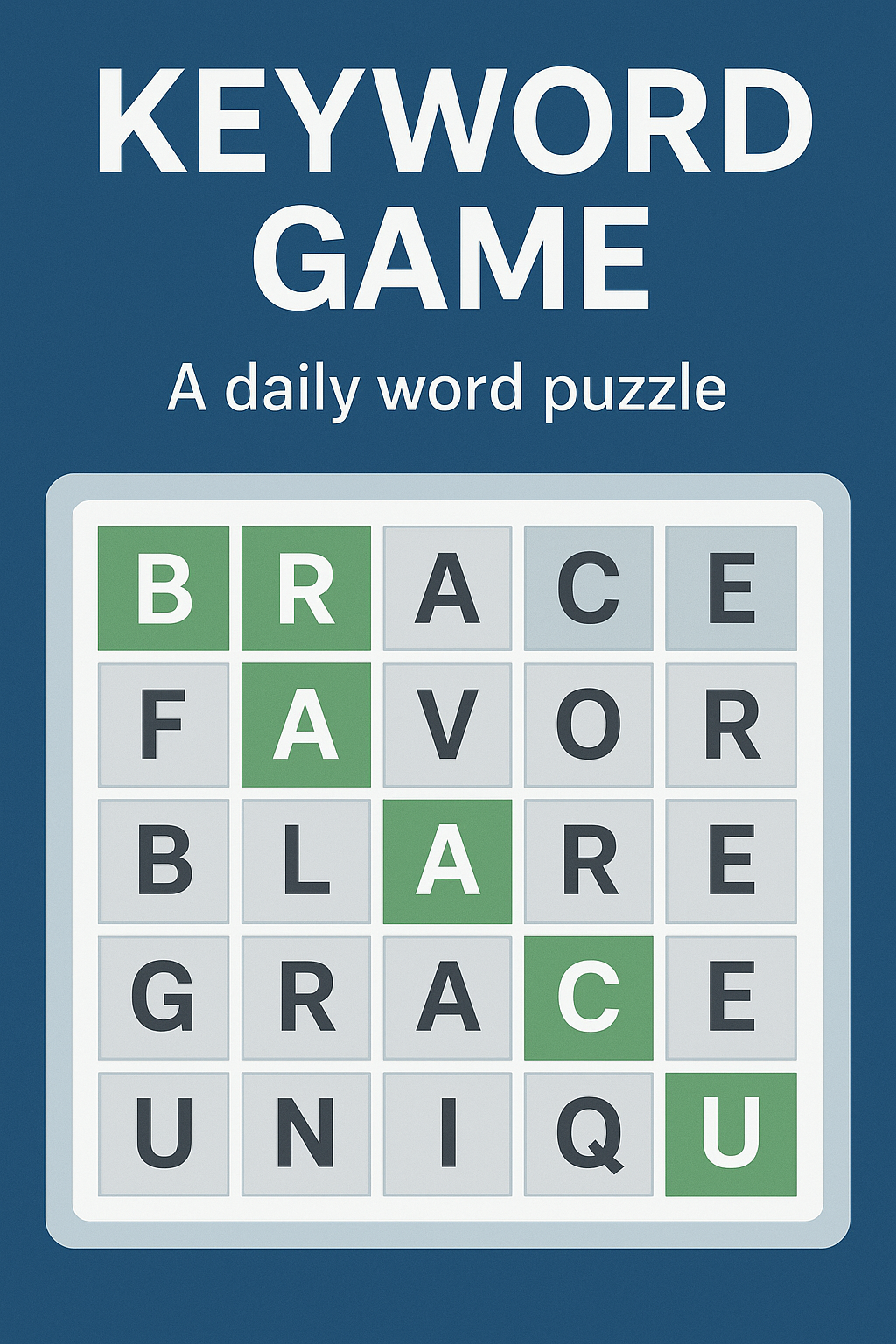
The Keyword Game: Inside The Washington Post’s Addictive Six-Letter Puzzle
The keyword game is a fresh, daily word puzzle from The Washington Post that challenges players to guess a six-letter keyword that completes six vertical words — each missing one letter — and it’s quickly become a favorite for Wordle fans and crossword lovers alike.
Below I’ll walk you through what the keyword game is, how it works, winning strategies (practical, playable tips), common pitfalls, and why it’s such a brilliant little test of pattern recognition and vocabulary. I’ll also point you to helpful walkthroughs and code-driven approaches people use when they want to analyze puzzles more deeply. If you want more puzzle culture, game breakdowns, or clever word tricks after this, check out The Reca Blog for more insightful articles.
What the Keyword Game Is — rules, layout, and daily play
The keyword game presents a crossword-like grid made from six vertical words. Each vertical word has exactly one missing letter; those six missing letters, when placed left to right, spell the secret six-letter keyword you must discover. Players make full six-letter guesses for the keyword; each guess simultaneously fills the missing letter in every vertical word where that letter belongs, and the puzzle gives feedback so you can refine your next guess.
A few practical details:
- There is a new keyword puzzle every day.
- You get unlimited guesses, but scoring rewards efficiency — solving in fewer guesses and less time is better. The ideal — “perfect” — score is solving the puzzle in 6 guesses (one correct missing-letter placement per guess).
- The interface shows which letters are correct in each vertical word, so each guess yields information you can use to solve other words in the set.
This mix of a single shared keyword and multiple intersecting words makes the keyword game feel part-Wordle, part-mini-crossword: you’re working with pattern constraints that cascade across all six short words.
Why the keyword game is clever (and why it hooks people)
At first glance the keyword game looks simple — find six letters that complete six words. But that simplicity contains a clever design: every guess yields information across six different contexts. A letter that seems to “fit” in position 3 of the keyword may solve part of one vertical word but reveal a contradiction in another, forcing you to think in terms of letter combinations and word families rather than isolated guesses. That multi-context feedback is what creates satisfying “aha” moments.
The game’s appeal comes from:
- Fast, daily play — it’s short enough to do every day but layered enough to feel rewarding.
- Pattern solving under constraints — you’re not just trying words; you’re trying letters that must simultaneously satisfy six word patterns.
- Immediate visual feedback — seeing the vertical words fill in creates momentum.
Because of that feedback loop, players report the same addictive feeling you get from daily Wordle or crosswords: a compact brain workout with measurable progress.
How to play — step-by-step guide for beginners
- Survey the grid. Look at each vertical word and note letters already present. Each missing letter corresponds to one position of the six-letter keyword.
- Make a full six-letter guess. Enter any six-letter word as your first keyword guess. Even a mediocre first guess is useful because it will fill in letters across the vertical words and reveal or eliminate many possibilities.
- Analyze feedback. The game highlights which letters are correct in which vertical words. Use those placements to deduce likely letter candidates for remaining blanks.
- Refine with targeted guesses. Use words that test likely letters in uncertain positions rather than purely random six-letter words. Prioritize guesses that give information about multiple ambiguous positions at once.
- Aim for efficiency. While unlimited guesses are allowed, the challenge (and the fun) is in reducing the number of attempts to reach that perfect six-guess solve.
If you want a more technical “how-to” (including keyboard shortcuts and tips for the web interface), there are helpful walkthroughs and community posts that document small UI tricks.
Practical strategies to win the keyword game (tested tips)
Below are tactical approaches players use to speed up solves.
1. Pick a smart opening word
Your opening guess should try to place common letters across multiple positions. Unlike Wordle (where letter position matters but words are independent), a good opening in the keyword game places useful letters into the vertical words so you can validate multiple letter-slot pairings in one shot.
2. Use pattern-filling guesses
After the first reveal, build guesses that intentionally test ambiguous letters in two or three positions at once. For example, if positions 2 and 5 are unclear, choose a real six-letter word that uses plausible letters in both slots. This reduces the number of rounds needed to eliminate possibilities.
3. Think in terms of word families
Look for recognizable fragments in the vertical words. If a vertical word looks like B_A_E, that suggests families like “brave / brace / blare” and that narrows down the letter choices for the keyword. Cross-check those candidates against the other verticals. The Washington Post
4. Favor high-utility letters
If you’re stuck, choose guesses that use frequent English letters (E, A, R, I, O, T), but placed strategically in the positions that will test the most uncertainty across the grid.
5. Use process-of-elimination rather than blind guessing
Because the six missing letters must also form a six-letter English word, not every combination of letters is allowed. Cross-filter letter candidates by checking whether they can form legitimate English words — this powerful constraint is what distinguishes talented solvers.
6. Keep a list (mentally or on paper) of candidate keywords
When you get multiple partial confirmations, try mentally or physically listing candidate six-letter words that match the confirmed letters. Then see which fit all verticals. Some players keep quick notes; others train a mental short-list. For players who enjoy coding, folks have used word lists and scripts to generate candidate keywords from the visible patterns.
Technical help and community tools (for the curious and the obsessed)
If you enjoy digging in deeper, the community has produced scripts and approaches that fetch daily puzzle data and use local word lists to compute candidate keywords. Those projects usually:
- Pull the puzzle’s JSON or grid data (where publicly reachable)
- Convert visible placeholders into regex-like patterns
- Cross-check against wordlists for feasible keywords
- Rank candidates by frequency or plausibility
This is more than cheating; it’s a fun programming exercise in constraint solving and applied linguistics. One example is a small script that generates candidate keywords by mapping the missing positions and testing combinations against a local dictionary. Use responsibly and for learning. Gist
Common rookie mistakes to avoid in the keyword game
- Treating the six letters independently. Remember each guess must be a real six-letter word and each letter placement affects six vertical words.
- Chasing low-probability letters. If a letter fits one vertical only marginally but breaks many others, deprioritize it.
- Overlooking word length clues. The visible fragments often point clearly to a narrow set of possibilities; don’t ignore those easy wins.
Avoid these and you’ll shave guesses off your average.
Why the keyword game matters for word-game culture
The Washington Post designed Keyword as a neat hybrid of micro crossword and Wordle mechanics — it’s compact, social (people share their perfect-solve streaks and times), and approachable. It sits in the sweet spot of today’s casual puzzle trend: short daily rituals that still reward skill and pattern recognition. News outlets expanding their games suites do more than entertain; they build daily habits and community around language play.
Where to read more and keep improving
- The Washington Post’s official Keyword page and help center explain the rules and scoring mechanics in plain language — great if you just want authoritative instructions.
- Player guides and strategy posts (blog walk-throughs) offer practical tips for improved solving.
- If you like coding puzzles, community scripts that generate candidate words demonstrate how constraint-solving frameworks work in practice.
And for a steady stream of thoughtful takes on games, puzzles, and language play, don’t forget to check The Reca Blog — it’s a solid stop for follow-up reads and deeper breakdowns.
Final Words
The keyword game is small, elegant, and a sharply rewarding mental exercise: six letters, six words, unlimited guesses, and plenty of strategy. Whether you play purely for fun, chase the perfect six-guess solve, or tinker with scripts that propose candidate words, there’s something in this little puzzle for almost every curious mind. Try it tomorrow, and the next day, and see how your pattern recognition improves — and if you want more game breakdowns, tips, or advanced puzzle play guides, head over to The Reca Blog for more insightful articles.





Leave feedback about this